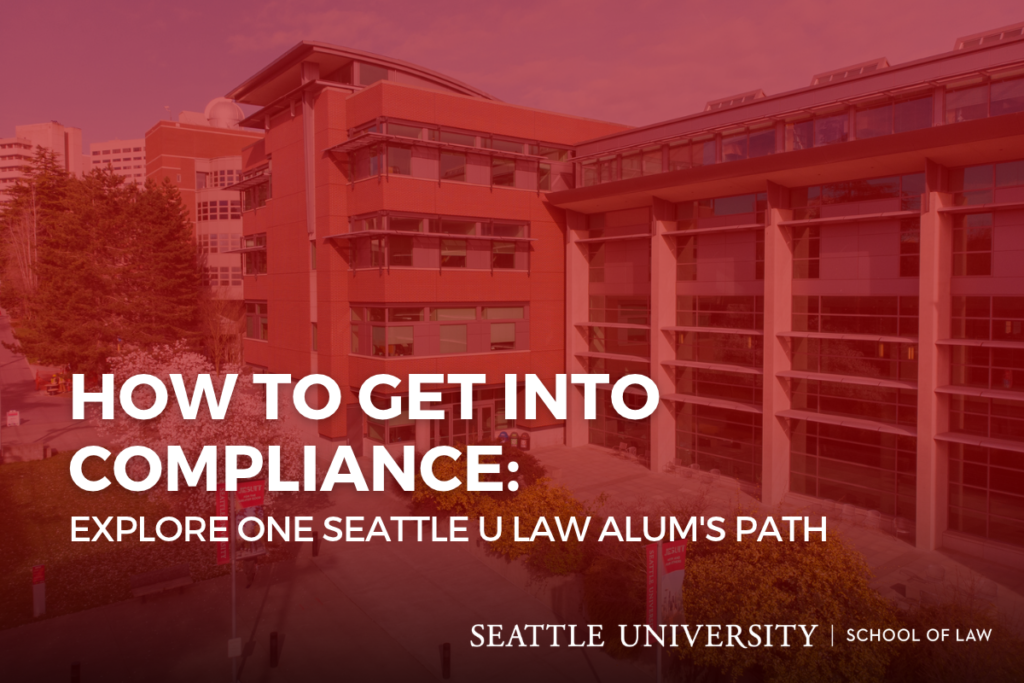
If you’re wondering how to get into compliance, the answer may start with the career you already have. A career in compliance doesn’t always begin in compliance. Experience in IT, finance, human resources, or another field can provide a starting point. The challenge is learning how to apply that experience to the rules and risks organizations manage every day.
During a recent Seattle University School of Law webinar, Assistant Dean Kelli Rodriguez spoke with alumna Katie Hairston about her path from military IT to cybersecurity compliance. Today, Katie is a Senior Security Governance Manager at a global software-as-a-service (SaaS) technology company, where she leads work in governance, risk management, and compliance. She also earned Seattle U Law’s online Master of Legal Studies (MLS) in Compliance and Risk Management while working.
Watch the webinar recording below, or read about Katie’s career transition and advice for prospective students.
Watch the full webinar
Careers in Compliance: Where an MLS Can Take You
How do you get into compliance from another career?
Professionals can transition into compliance from a variety of backgrounds. Many kinds of experience can provide a foundation for compliance work, particularly when it includes an understanding of regulatory compliance: the laws, regulations, and industry standards.
Katie Hairston’s career is one example. After college, she joined the Army through an ROTC scholarship and served in the Signal Corps, which involved a broad range of IT-related duties. For nearly 14 years, her work involved radios, satellites, account systems, and help desk management. After leaving the military, she joined the payment card industry (PCI) compliance team at a global retail company.
In that role, Katie applied her technical knowledge to a new set of responsibilities. She began to see how compliance requirements helped protect customer credit card data across the company’s stores and online operations.
“That was probably the first time I went from just being a doer and implementer of things to understanding why those things are so important.”
What is Cybersecurity Compliance?
Cybersecurity Compliance is the process of aligning an organization’s security controls, policies, and operational practices with external legal, regulatory, and industry standards (such as GDPR, PCI-DSS, or ISO frameworks) to protect sensitive data and mitigate risk. Learn more about a concentration in Cybersecurity Compliance.
What does a cybersecurity compliance professional do?
Cybersecurity compliance involves helping an organization meet applicable security and privacy requirements. Professionals in this area review laws, regulations, and industry standards; work with colleagues to understand where requirements apply; and help translate them into policies, processes, and technical controls. This work is often part of governance, risk, and compliance (GRC), a growing area for professionals building careers in compliance.
Katie’s day-to-day work is centered around evolving cybersecurity regulations and new data privacy laws as they’re published. “How do we identify those requirements quickly?” she posits. “How do we recognize when they are relevant to our company and to the services we provide, and when they’re not, get them interpreted into controls or into written policy, not just for the sake of passing audit, but for making ourselves better?” Balancing compliance, growth, security, and consistency, among other things, is key.
Compliance also acts like a “communications hub”, connecting parts of a business that might not realize they need to align. Katie noted that human resources is often overlooked: hiring practices, background checks, employee onboarding, and system access all tie into data privacy laws like the EU’s General Data Protection Regulation (GDPR) and federal government contracts.
Compliance can also help the business pursue opportunities. “We get a lot of inquiries from our sales and marketing teams who say, ‘Hey, if we can achieve this certification, we can expand into this new market. What would it take for security to get there?’” Part of the process is quickly evaluating all requirements, determining their applicability and the labor involved, and then bringing the information to leadership. “It’s a really different way of operating,” Katie says, “and it’s made my job a lot more challenging, but also a lot more fun.”
What skills transfer into a compliance career?
To build strong compliance skills, Katie recommends starting with an understanding of the business itself. What does the organization do? What information does it collect or use? Which laws and standards apply to those activities? A professional who already understands an industry or its technology brings valuable context to those questions.
She also credits her MLS coursework with helping her read and interpret legal material, identify what matters for her organization, and communicate it clearly. Rather than handing executives a long explanation of a new rule, she learned to focus on the changes that affect business decisions and operations. She was able to apply those skills in her current company, and they are transferable across industries.
It’s a reason that the Seattle U MLS focuses on the compliance core: reading, synthesizing, and communicating rules, statutes, legislation, and court cases. That approach reflects the program’s emphasis on interpreting legal sources and applying them to workplace situations, including coursework in compliance, risk management, and audit.
Do you need a law degree to work in compliance? (MLS vs. JD)
Not necessarily. A Juris Doctor (JD) is the degree typically pursued by those preparing to become attorneys. An MLS is designed for professionals who want to understand and apply law and regulation in their work without becoming practicing lawyers. It does not qualify graduates to practice law or sit for the bar.
Katie was already working in compliance when she enrolled. She saw the connection between class and work during her first semester: while her employer was negotiating with audit firms, a topic from her introductory compliance course helped her recognize and explain a contract concern raised by an internal audit team.
Her coursework also helped her connect cybersecurity requirements with privacy and broader business decisions. In her current role, Katie’s team works with software developers earlier in the product process so compliance issues can be considered before launch rather than addressed at the last minute.
Can you earn an MLS while working full time?
Yes. Katie completed Seattle U Law’s fully online MLS over six consecutive part-time semesters while managing her job and family responsibilities. She emphasized that the experience required planning, particularly around reading, writing, and major assignments.
Her advice was practical: talk with family members about how study time will fit into the week; give managers advance notice of demanding periods such as finals; and communicate with professors when work travel or time-zone changes could affect deadlines. She also found it helpful to discuss what she was learning with attorneys at work, which led to new conversations and opportunities to contribute.
Seattle U Law offers options for students navigating changes in work or personal circumstances, including the possibility of taking a leave of absence. Students should speak with the program about their individual situation and available options.
Considering a career in compliance?
Katie’s compliance career path is a reminder that entering compliance does not necessarily mean starting your career over. Her experience in military IT gave her a technical foundation; her work in PCI compliance helped her see how rules operate in practice; and her MLS studies added a legal perspective she could use on the job.
“Take a bet on yourself… There is nothing but opportunity in this space.” – Katie Hairston
Interested in Seattle University School of Law’s online MLS in Compliance and Risk Management? Request information to explore the curriculum, concentrations, and how the program could fit your professional goals.